Previous
Next

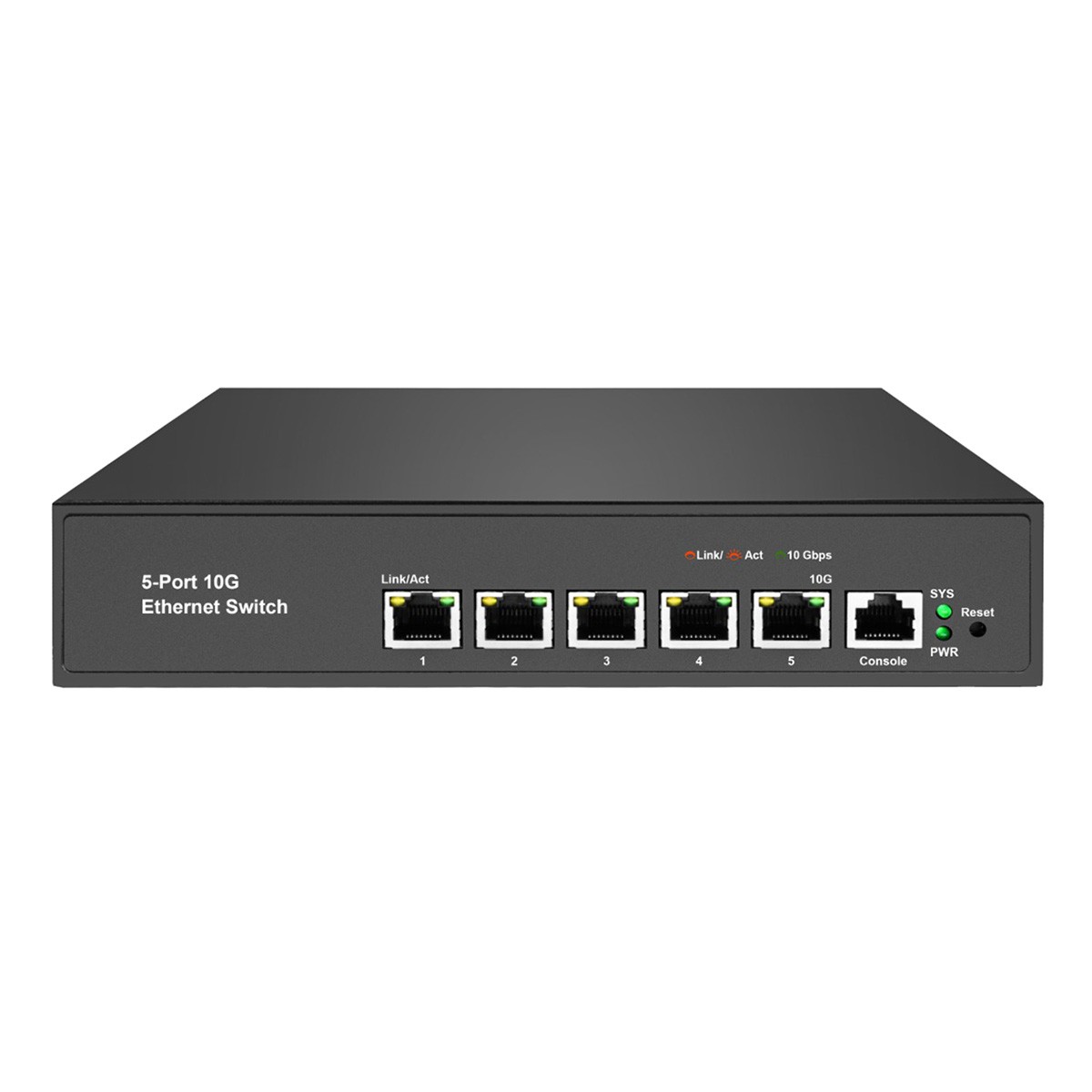
The Abart Pro ABP-SW10GM05 is a 5-port, manageable L3 10GbE network switch that is the ideal solution for a small but highly efficient computer network that meets the requirements of advanced users. Switch configuration is greatly simplified thanks to the web-based user interface and management tool. With its rich L3 management features, the ABP-SW10GM05 switch is capable of providing high bandwidth even to the most demanding workgroups at the edge of the network, and in small networks it can serve as a backbone for Gigabit switches and high-speed servers.

Switch Abart Pro 5x 10GbE RJ45 L3 Managed ABP-SW10GM05

KOD ABP-SW10GM05 Category Network switches EAN 5900415053446 Delivery time 3 - 5 days
zł852.85 Tax excluded
zł1,049.00
Tax included
0/5

Przedłużona ochrona serwisowa EasyProtect®

EasyProtect Logo

Zyskaj nawet 3 lata dodatkowej ochrony dla swojego sprzętu

Dowiedz się więcej

The Abart Pro ABP-SW10GM05 is a 5-port, manageable L3 10GbE network switch that is the ideal solution for a small but highly efficient computer network that meets the requirements of advanced users. Switch configuration is greatly simplified thanks to the web-based user interface and management tool. With its rich L3 management features, the ABP-SW10GM05 switch is capable of providing high bandwidth even to the most demanding workgroups at the edge of the network, and in small networks it can serve as a backbone for Gigabit switches and high-speed servers.

The Abart Pro ABP-SW10GM05 network switch is designed exclusively for the networking needs of growing businesses, offering a wide range of management and security features. These devices are cost-effective for small and medium-sized businesses, providing ideal solutions for a variety of networking scenarios.

Key features

  • Supports IEEE 802.3/802.3u/802.3ab/802.3bz/802.3x/802.3cb/802.3an standards.
  • Features 5 RJ45 100M/1000M/2.5G/5G/10Gbps ports.
  • Supports automatic MAC address learning and auto aging.
  • Operates in store-and-forward mode.
  • LED indicators for monitoring power, connection/activity.
  • Supports QoS, port mirroring, link aggregation protocol.
  • Full metal housing.

Strong business process capabilities

  • With IEEE 802.1Q VLAN support, VLANs can be flexibly divided according to needs.
  • Supports VLAN for voice, configures QoS parameters for voice data streams, increases the priority of voice data stream transmission, and ensures call quality.
  • Supports QoS, three priority modes based on Endpoint, 802.1P, and DSCP, and four queue scheduling algorithms: Equ, SP, WRR, and SP+WRR.
  • Supports ACL, according to match rule configuration, action processing, and temporary packet filtering permissions, and provides flexible security access control policies.
  • Supports IGMP V1/V2 multicast protocol and IGMP Snooping for multi-station HD monitoring and video conference access.
  • Supports VLAN multicast and multicast filtering for efficient data transmission, saving network bandwidth and reducing network load.
  • Supports port monitoring by copying copies of monitored port packets to the monitoring port to enable network monitoring.

Complete security protection mechanism

  • Supports quadruple binding of IP address, MAC address, VLAN, and port for packet filtering.
  • Supports ARP protection against ARP spoofing and ARP flooding attacks, such as grid spoofing and relay attacks, which are common in local networks.
  • Supports IP source protection to prevent illegal address spoofing, including MAC spoofing, IP spoofing, and MAC/IP spoofing.
  • Supports 802.1X authentication, which provides authentication for local network computers and controls the authorization status of controlled endpoints based on authentication results.
  • Supports port security and stops learning when the maximum number of MAC addresses is reached to prevent MAC address attacks and control port network traffic.

Diverse reliability protection

  • Supports STP/RSTP/MSTP spanning tree protocols, eliminating Layer 2 loops and enabling link backup.
  • Supports spanning tree security to prevent all forms of malicious attacks on devices in the spanning tree network.
  • Supports static and dynamic aggregation to effectively increase link bandwidth, achieve load balancing, create link backups, and improve link reliability.

Easy operation and maintenance

  • Supports various management and maintenance methods, such as web management, CLI (console, Telnet) commands, and SNMP (V1/V2/V3).
  • Supports HTTPS, SSL V3, TLSV1, SSHV1/V2 encryption for more secure management.
  • RMON, system logs, and end-to-end traffic statistics for network optimization and transformation.
  • Supports cable detection, Ping detection, and Tracert detection, which facilitates the analysis of faulty network nodes.
  • Supports LLDP protocol to help the network management system check and evaluate link communication status.
  • Supports CPU monitoring, memory monitoring, operational and time permissions, and provides a flexible access control strategy.

Technical specifications

  • Power supply AC 100–240 V 50/60 Hz
  • Standards: IEEE 802.3/802.3u/802.3ab/802.3bz/802.3x/802.3cb/802.3an
  • Ports 5 RJ45 ports 100M/1000M/2.5G/5G/10Gbps, 1 console port
  • Indicators (LEDs): 5 connection/activity indicators, 5 10G speed indicators, power indicator, system operation indicator.
  • Network Media (cable): 100BASE-TX: Category 5 or higher UTP/STP (max. 100 m), 1000BASE-T: Category 5e or higher UTP/STP (max. 100 m), 2.5GBASE-T: UTP/STP category 5e or higher (max. 100 m), 5GBASE-T: UTP/STP category 5e or higher (max. 100 m), 10GBASE-T: UTP category 6 (max. 55 m) or STP category 7 (max. 100 m)
  • Transfer method: Store and forward
  • MAC address table: 16K
  • Switching capacity: 100 Gbps
  • Packet forwarding rate: 74.4 Mpps
  • 12 Mbit buffer
  • Jumbo frame: 12 KB
  • Dimensions: 218*165*44 mm
  • Operating temperature: 0℃ ~45℃ (0℉~113℉)
  • Storage temperature: -40℃ ~70℃ (-40℉ ~158℉)
  • Operating humidity: 10%~90% non-condensing
  • Storage humidity: 5%~95% non-condensing

Software Features

  • L3 Switching Features
  • • Static Routing (IPv4/IPv6)
  • • Address Resolution Protocol (Static ARP)
  • L2 Switching Features
  • • 16K MAC Address Table
  • • 12K Jumbo Frame
  • • Flow Control (802.3x (Full-duplex), Back-Pressure (Half-duplex))
  • • Spanning Tree
  • - IEEE 802.1D (STP)
  • - IEEE 802.1w (RSTP)
  • - IEEE 802.1s (MSTP)/16 instances
  • - Auto Edge Port
  • - BPDU Filtering
  • - ERPS
  • • Link Aggregation
  • - IEEE 802.3ad LACP
  • - Static Trunk
  • - Max 8 Group
  • - Max 8 Ports/Group
  • - Traffic Load Balancing
  • VLAN
  • • Surveillance VLAN
  • - 16 OUI Mode (Auto/Manual)
  • • Voice VLAN
  • - 16 OUI Mode (Auto/Manual)
  • • QinQ (IEEE 802.1ad)
  • - Basic
  • • GARP VLAN Registration Protocol (GVRP)
  • • 4096 Static VLAN/Port-based
  • • IEEE 802.1Q Tagged-based
  • • 8 groups Protocol-based
  • • 256 MAC-based
  • Multicast
  • • Common
  • - 256 Multicast Groups
  • - Immediate Leave
  • - Static/Forbidden Router Port
  • - Static/Forbidden Forward Port
  • - 128 profiles Filtering
  • - Throttling
  • • IGMP Snooping
  • - IGMP v1/v2
  • - IGMP v3 Basic (BISS)
  • - IGMP v2/v3 Querier
  • • MLD Snooping
  • - MLD v1/v2
  • • Multicast VLAN Registration (MVR)
  • - IPv4
  • Quality of Service (QoS)
  • • Trusted QoS/Priority 8 Queue
  • • Queue Scheduling
  • - WRR
  • - WFQ
  • - Strict Pripority
  • - Hybrid(WRR+SP or WFQ+SP)
  • • Class of Service
  • - Port-based
  • - 802.1p
  • - IP TOS Precedence
  • - IP DSCP
  • • Rate Limit
  • - Port-based (Ingress/Egress)
  • Access Control List (ACL)
  • • ACL Type
  • - L2/L3/L4
  • - 512 MAC-based
  • - 512 IPv4-based
  • - 512 IPv6-based
  • • Access Rules
  • - 1024
  • Security
  • • AAA Authentication
  • • 8 TACACS+
  • • 8 RADIUS
  • • Authentication Manager
  • - IEEE 802.1X
  • - MAC Auth
  • - Web Auth
  • - Guest VLAN
  • - Port-based
  • - Host-based
  • • Account Manager
  • - Local Authenticatoin
  • - 8 Multiple User Account
  • - Multi-Level Securiy (Manager/Operator)
  • - Password Recovery Procedures
  • • Management Access
  • - Management VLAN
  • - 256Management ACL
  • • SSL
  • - SSLv2
  • - SSLv3
  • - TLSv1
  • • WebUI
  • - HTTPS
  • • CLI
  • - SSH v1/v2
  • • Port Security
  • - 256 Dynamic Lock
  • • Storm Control
  • - Broadcast
  • - Unknown Multicast
  • - Unknown Unicast
  • • Spanning Tree
  • - BPDU Guard
  • • Protected Port (Port Isolation)
  • • Black Hole MAC
  • • CPU Defence Engine
  • • DoS Prevention
  • • DHCP Snooping (with Option 82)
  • • Dynamic ARP Inspection
  • • 256 IP Source Guard
  • • IP/MAC/Port Binding (IMPB)
  • • Dynamic VLAN Assignment
  • IPv6
  • • IPv6 Host
  • - Auto Configuration
  • - Static IPv6 Address and Prefix Length
  • - Static IPv6 Default Gateway
  • - IPv6 Neighbor Discovery (ND)
  • - IPv6 Duplicate Address Detection
  • - ICMPv6
  • • IPv6 Application
  • - HTTP/HTTPS
  • - TELNET
  • - SSH
  • - SNMP
  • - TFTP
  • - Syslog
  • - PING
  • - DHCPv6
  • Management
  • • CLI
  • - 3 sessions Console
  • - 3 sessions Telnet (RFC854)
  • • WebUI
  • - HTTPS
  • • SNMP(v1,v2c,v3)
  • • File Management
  • - Firmware Upgrade/Backup
  • - Dual Images
  • - Configuration Download/Backup
  • - Multiple Configurations
  • • Upload/Download
  • - TFTP (RFC783)
  • - HTTP
  • - UART
  • • Time Management
  • - Local
  • - SNTP
  • • Port Management
  • - Friendly Port Name (Port Description)
  • - Error Disabled Recovery
  • • Line Management
  • - Console
  • - Telnet (RFC854)
  • - SSH v1/v2
  • • DHCP
  • - Client
  • • DNS
  • - Client
  • • Software Reset Button
  • • IEEE (802.3az)
  • • 32 entries / type RMON Management
  • Discovery
  • • IEEE 802.1AB Link Layer Discovery Protocol (LLDP)
  • • ANSI/TIA-1057 LLDP Media Endpoint Discovery (LLDP-MED)
  • Diagnostics
  • • UDLD
  • • Mirroring
  • - 4 sessions port-based (Many to One)
  • • Syslog (RFC3164)
  • - Local RAM
  • - Local Flash
  • - 8 Remote Server
  • • System Diagnostics
  • - CPU Utilization
  • - Memory Utilization
  • - Port Utilization
  • - Technical Support Log
  • • Port Diagnostics
  • - Cable Test
  • - Fiber Module Status
  • • Network Diagnostics
  • - Ping Test
  • - Traceroute
  • MIB
  • • RFC1213 MIBII (System & Interface groups)
  • • RFC2819 RMON I (1,2,3, & 9 groups)
  • • RFC1215 Generic Traps
  • • RFC1493 Bridge
  • • RFC2674 Bridge MIB Extensions
  • • RFC2737 Entity
  • • RFC3635 Ethernet-Like
  • • RFC2863 Interface Group
  • • SNMP-Community-MIB
  • • SNMPv3-MIB
Comments (0)

You may also like: